Research

Medical LLMs

Large Language Models for Medicine

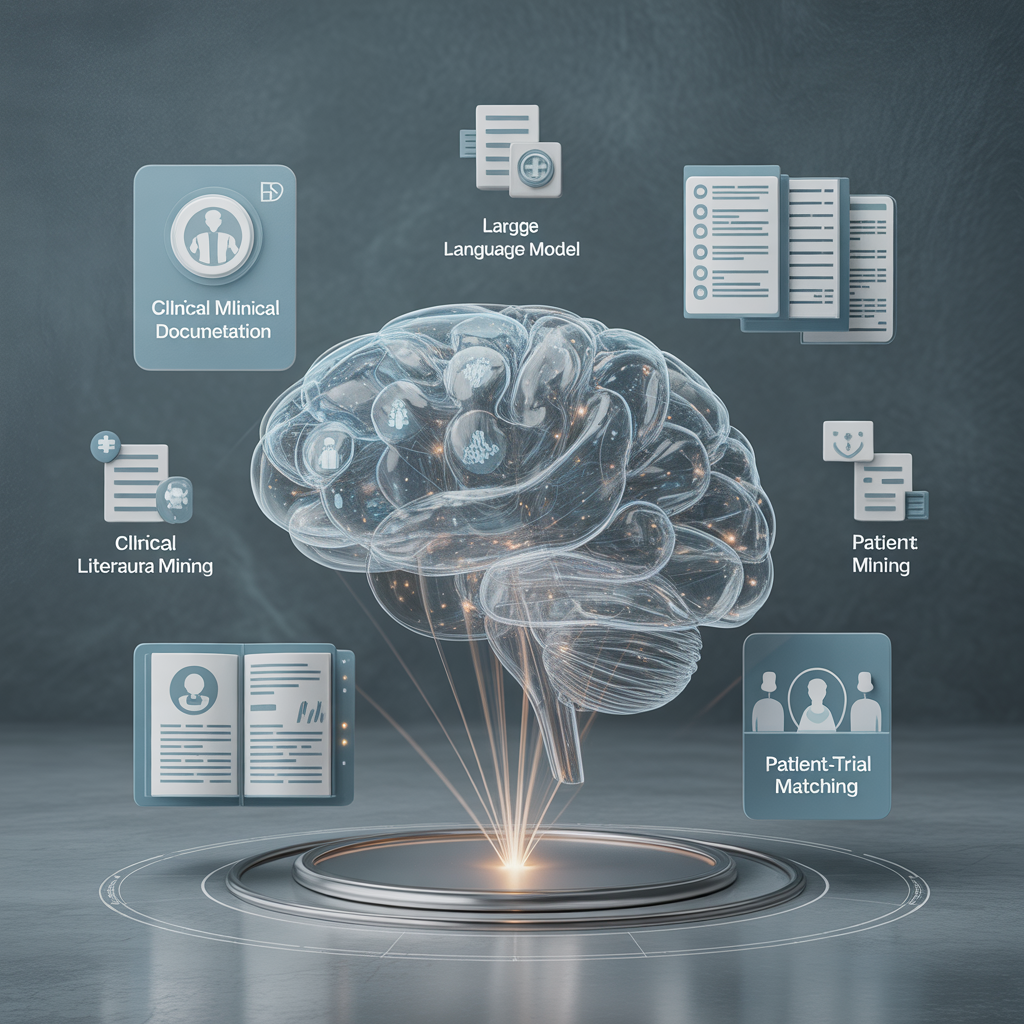
The lab focuses on specialized medical LLMs and AI agents that augment experts rather than replace them, with grounding, workflow fit, and measurable efficiency gains.

01Medical corpus
02Domain-specialized model
03Expert-in-the-loop workflow
04Evidence or documentation output

Recent papers

What this program is building

Selected recent and foundational papers, summarized around the task, why it matters, and the main technical result.

2026JAMIA

Compliance and Factuality of Large Language Models for Clinical Research Document Generation

1Protocol context
2LLM draft
3Factuality and compliance checks
Task
Evaluate whether LLM-generated clinical research documents are factual and compliant.
Why it matters
The work addresses the trust bottleneck for using LLMs in regulated clinical research workflows.
Main result
It clarifies where LLMs can help document generation and where verification must remain explicit.
Paper details
2025Nature Communications

A Foundation Model for Human-AI Collaboration in Medical Literature Mining

1Medical literature
2Foundation model
3Screening and extraction
Task
Train a medical literature mining model for study search, screening, and data extraction.
Why it matters
Systematic reviews and evidence synthesis are slow, expert-heavy bottlenecks in medicine.
Main result
The model supports human-AI collaboration by accelerating literature tasks while keeping experts in the loop.
Paper details
2025npj Digital Medicine

Accelerating Clinical Evidence Synthesis with Large Language Models

1Clinical studies
2LLM evidence workflow
3Synthesized findings
Task
Use LLM workflows to speed up evidence synthesis from clinical studies.
Why it matters
Faster evidence synthesis helps researchers and clinicians keep up with expanding biomedical literature.
Main result
The work shows how LLMs can support systematic evidence workflows when paired with structured verification.
Paper details
2025EMNLP

Process-Supervised Reward Models for Verifying Clinical Note Generation

1Source facts
2Stepwise verification
3Safer clinical note
Task
Verify clinical note generation by supervising the reasoning process, not only the final note.
Why it matters
Clinical documentation needs accuracy, traceability, and scalable quality control.
Main result
Domain-guided process supervision gives a path toward safer LLM-generated clinical notes.
Paper details
2025ACL Findings

Towards Adapting Open-Source Large Language Models for Expert-Level Clinical Note Generation

1Clinical context
2Open-source LLM adaptation
3Expert-style note
Task
Adapt open-source LLMs to produce clinical notes at expert-level quality.
Why it matters
Open models can lower the barrier for transparent, institution-specific clinical documentation research.
Main result
The paper maps how domain adaptation and evaluation move open LLMs closer to expert documentation tasks.
Paper details
2024Nature Communications

Matching Patients to Clinical Trials with Large Language Models

1Patient record
2Eligibility criteria
3Trial match decision
Task
Match patient records against trial eligibility criteria using LLMs.
Why it matters
Patient-trial matching is a major recruitment bottleneck and a strong translational use case for medical LLMs.
Main result
LLMs can read eligibility language and patient evidence to support scalable trial matching.
Paper details

Representative publication links

Interested in this program?

Send a concise note with the program name, your role, the problem you want to work on, and any relevant data, code, clinical setting, or research experience.

Contact Sunlab
Clinical AI Drug Discovery Synthetic Data