Research

AI for Clinical Trials

We build AI that helps design better trials, find the right patients, and turn published evidence into decisions faster.

Clinical trials are how new treatments reach patients, but they are slow, costly, and often fail over safety, efficacy, or enrollment. Our AI supports each step, from designing a trial to reviewing its evidence.

Designing trials and predicting their outcomes

Learning from past trials to forecast success and draft protocol elements, such as eligibility criteria, before a trial starts.

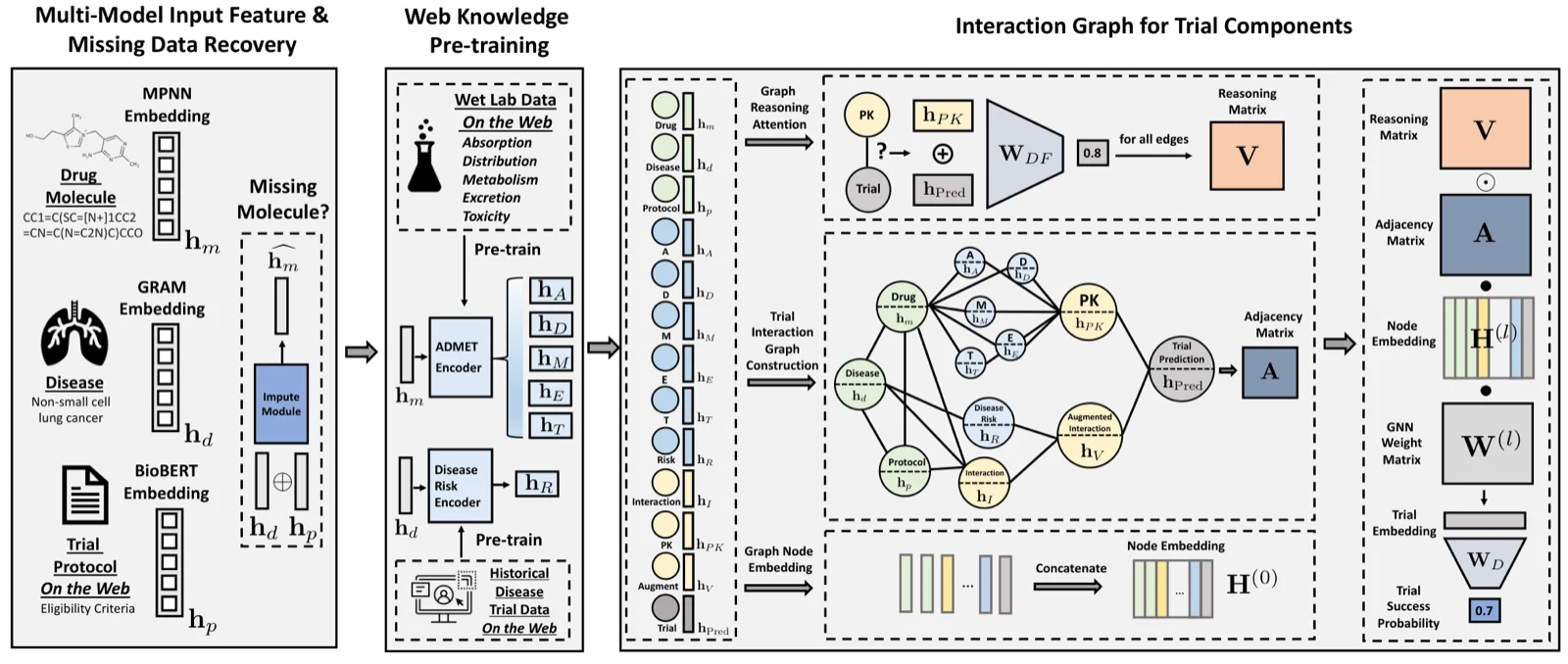
HINT links drug, disease, and protocol data in an interaction graph
HINT links drug, disease, and protocol data in an interaction graph. Figure from the paper.
The problem
Many trials fail over safety, efficacy, or recruitment problems; predicting outcomes early could spare patients and redirect resources toward trials likely to succeed.
What we built
A graph neural network that combines drug molecules, target disease, and eligibility criteria with pharmacokinetic and historical trial knowledge to predict whether a trial succeeds.
Why it matters
Reached F1 scores of 0.665, 0.620, and 0.847 on phase I, II, and III test trials; the benchmark dataset and code are public.
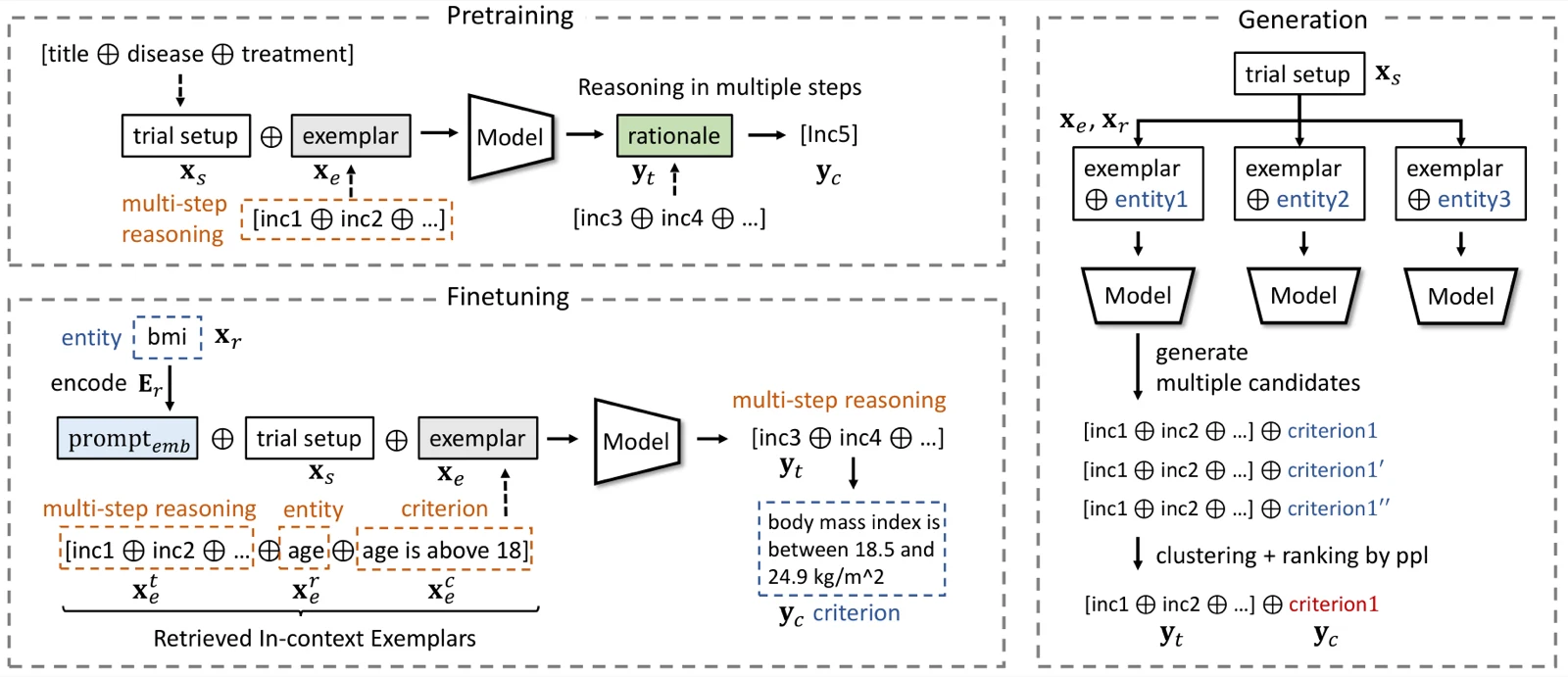
AutoTrial workflow: pretraining, instruction finetuning, and generating ranked candidate criteria
AutoTrial workflow: pretraining, instruction finetuning, and generating ranked candidate criteria. Figure from the paper.
The problem
Eligibility criteria decide who can join a trial; poorly designed criteria can leave a trial without enough patients.
What we built
A language model that drafts eligibility criteria from a trial's setup and similar past trials, and explains its reasoning step by step.
Why it matters
Tested on over 70K clinical trials; despite a much smaller model, it won about 60% of human-judged comparisons against GPT-3.5 baselines.

Matching patients to the right trials

Reading patient records and trial eligibility criteria together so that suitable patients and trials find each other faster.

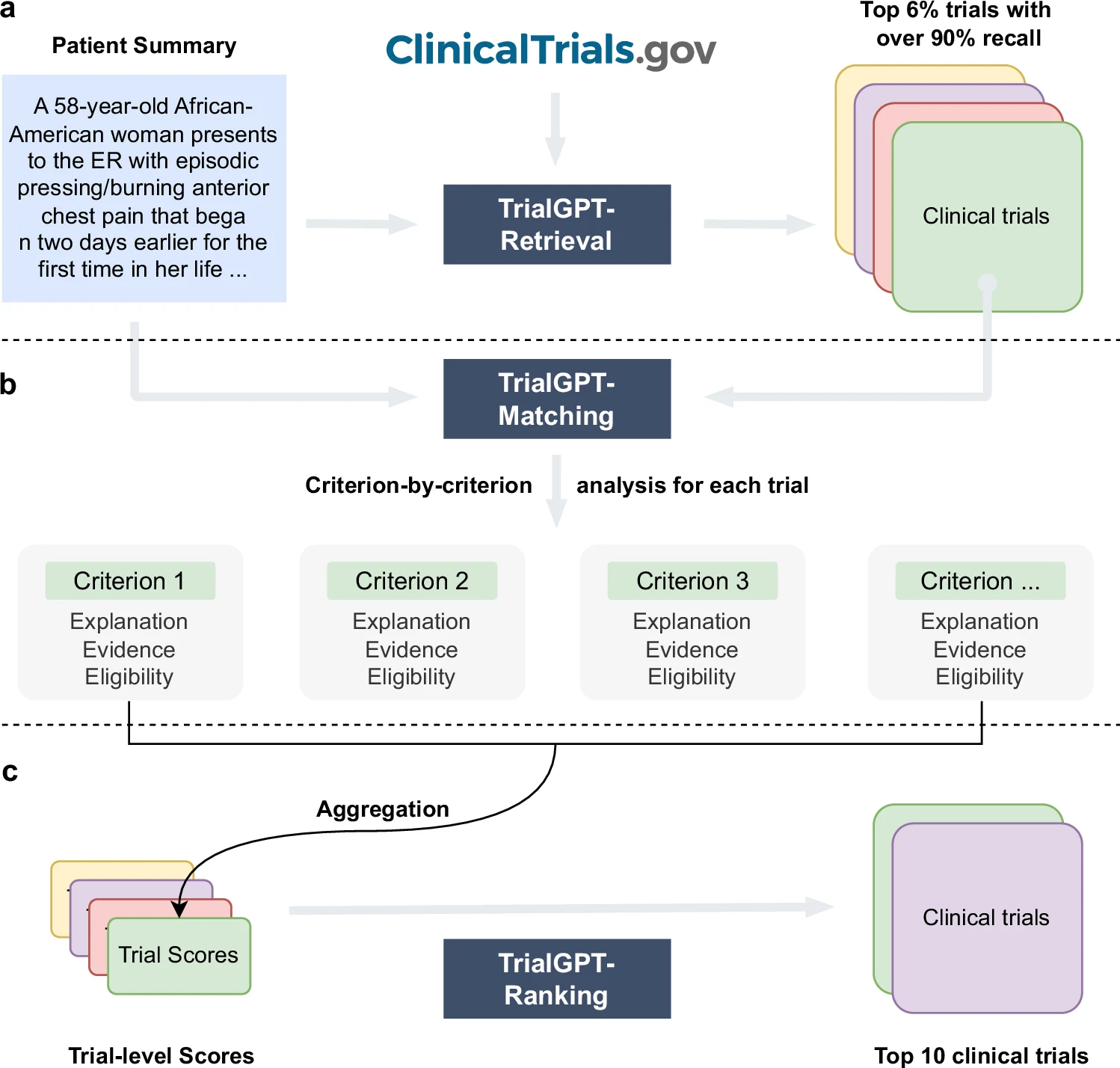
TrialGPT retrieves trials, checks each criterion, then ranks trials for a patient
TrialGPT retrieves trials, checks each criterion, then ranks trials for a patient. Figure from the paper.
Nature Communications · 2024

Matching patients to clinical trials with large language models

Jin et al. · led by NIH/NCBI, with Sunlab

The problem
Patient recruitment is a major bottleneck for trials, and checking a patient against every trial's criteria by hand is slow.
What we built
TrialGPT uses large language models to retrieve candidate trials, judge eligibility criterion by criterion with explanations, and rank trials for each patient.
Why it matters
Criterion-level eligibility judgments were 87.3% accurate, close to experts, and a user study showed a 42.6% reduction in screening time.
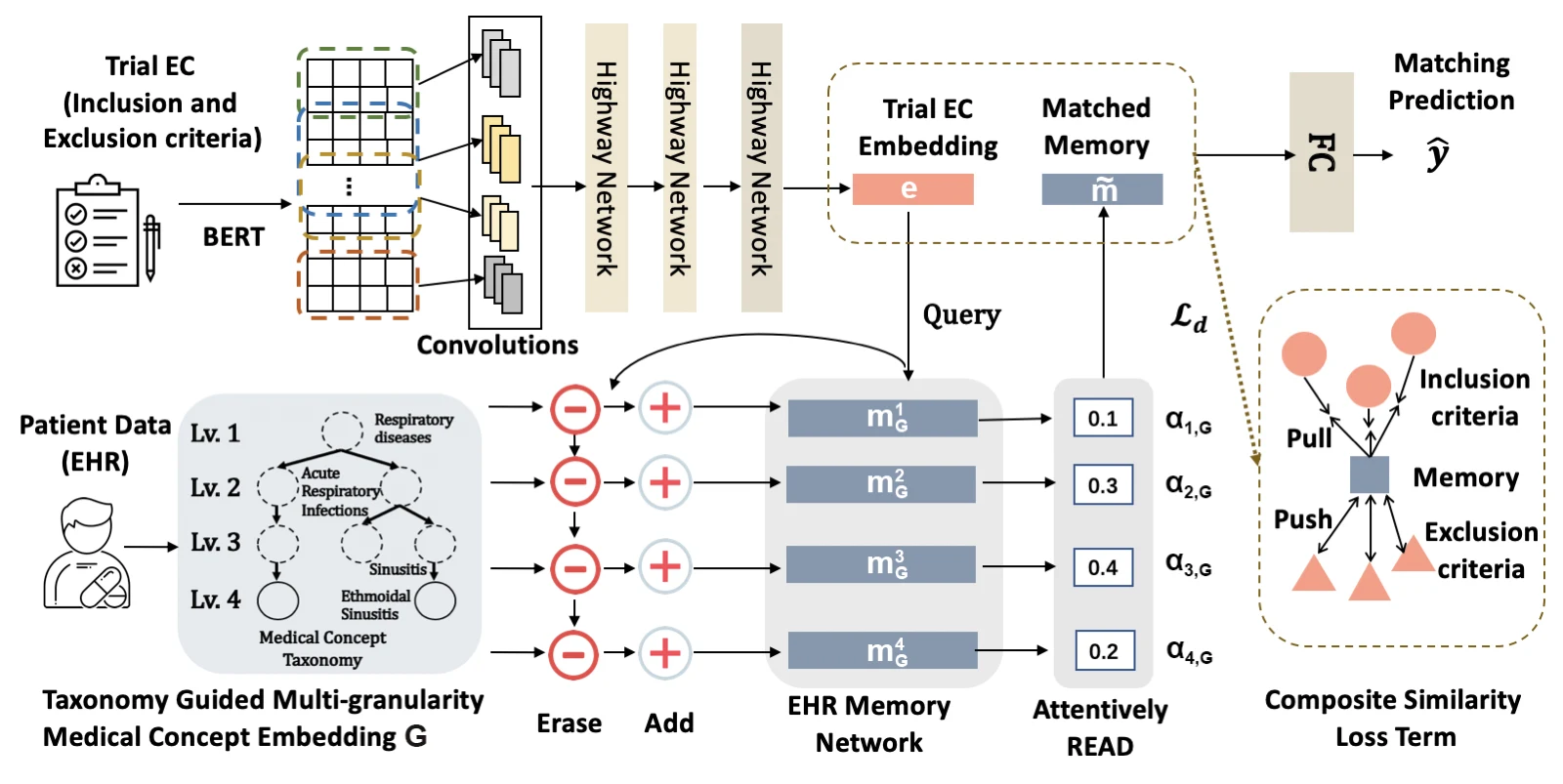
COMPOSE aligns eligibility-criteria text with a patient's health-record memory
COMPOSE aligns eligibility-criteria text with a patient's health-record memory. Figure from the paper.
The problem
Recruitment is often expensive and inaccurate because trial criteria are free text while patient records are structured and span many visits.
What we built
A two-path neural network that encodes eligibility criteria and longitudinal health records, pulling patients toward inclusion criteria and away from exclusion criteria.
Why it matters
Reached 98.0% AUC on patient-criteria matching and 83.7% accuracy on patient-trial matching, a 24.3% improvement over the best baseline.

Synthesizing clinical evidence with LLM agents

AI assistants that search, screen, extract, and synthesize published studies, with people checking every step.

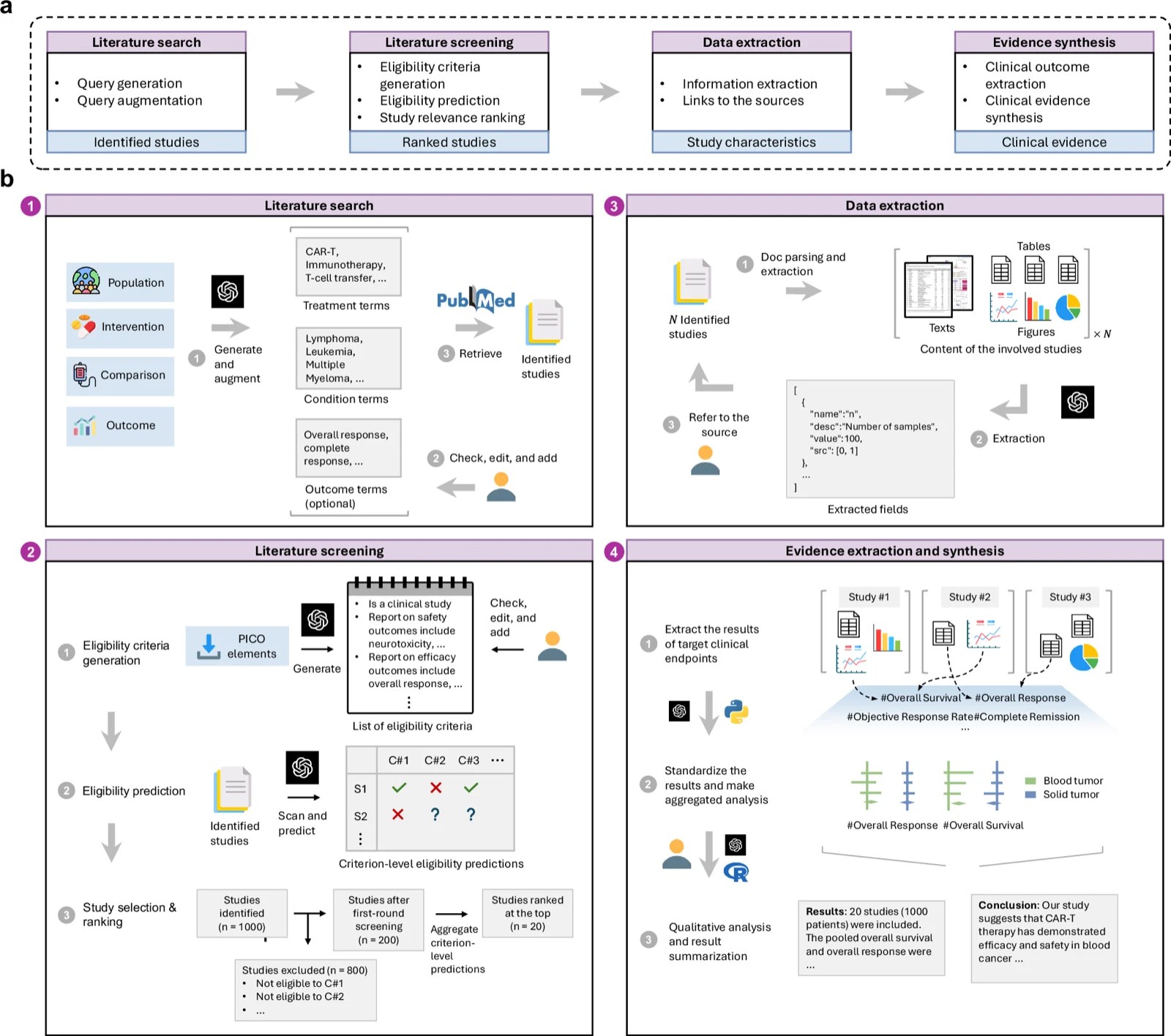
TrialMind covers search, screening, data extraction, and evidence synthesis
TrialMind covers search, screening, data extraction, and evidence synthesis. Figure from the paper.
The problem
Systematic reviews underpin treatment guidelines, but searching, screening, and extracting data from thousands of studies by hand takes a long time.
What we built
TrialMind, an LLM pipeline that generates search queries, screens studies against eligibility criteria, and extracts results with links back to the source text.
Why it matters
In a pilot study, working with TrialMind raised screening recall by 71.4% and cut screening time by 44.2%; data extraction time fell 63.4%.
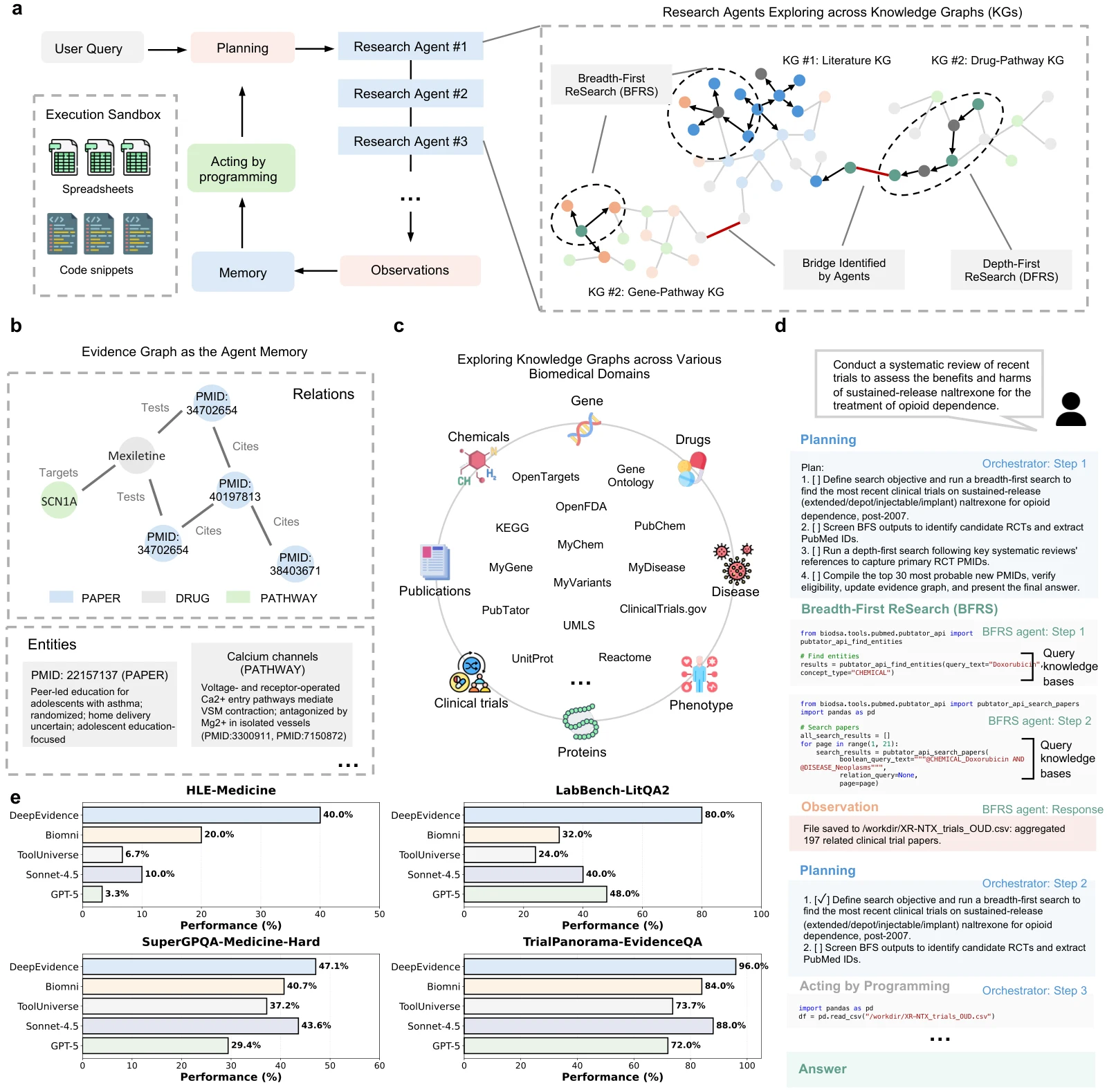
DeepEvidence agents explore knowledge graphs and record findings in an evidence graph
DeepEvidence agents explore knowledge graphs and record findings in an evidence graph. Figure from the paper.
The problem
Answering biomedical questions means connecting evidence scattered across literature, trial registries, and drug and gene databases, which is slow to do by hand.
What we built
DeepEvidence, a multi-agent deep research system that searches broadly and deeply across biomedical knowledge bases while building a traceable evidence graph.
Why it matters
Outperformed generic AI agents on four open benchmarks and showed substantial gains on seven new tasks spanning drug discovery to evidence-based medicine.

Open data and benchmarks for trial AI

Large, AI-ready clinical trial datasets and benchmarks that let the field train and fairly compare models.

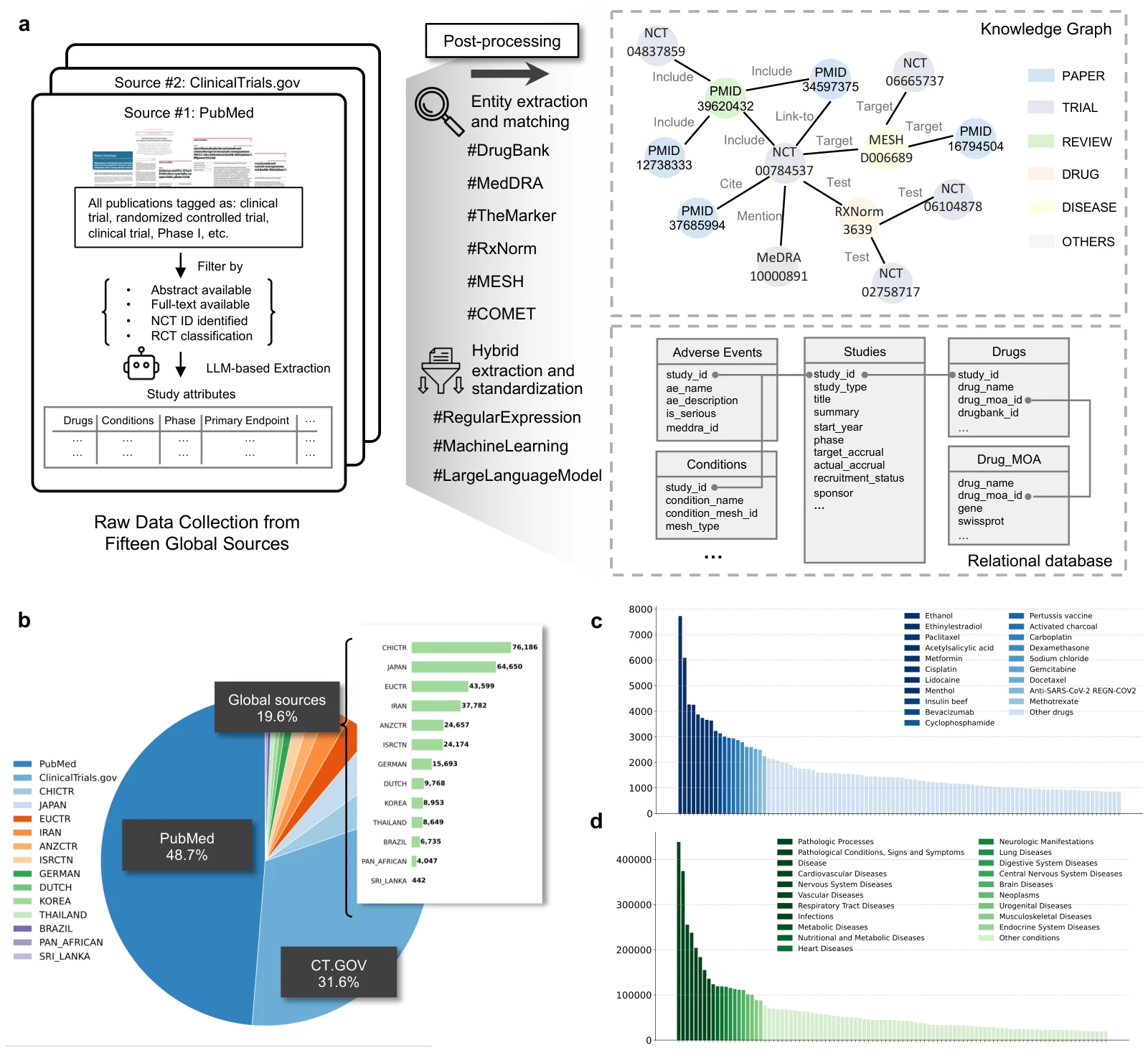
TrialPanorama gathers trial records from fifteen global sources into a linked database
TrialPanorama gathers trial records from fifteen global sources into a linked database. Figure from the paper.
The problem
General-purpose LLMs show limited clinical reasoning, and clinical research lacked a large, structured data foundation for training and testing them.
What we built
TrialPanorama links 1.6M trial records from fifteen global registries with ontologies and literature, yielding 152K samples across eight review and design tasks.
Why it matters
An 8B model trained on TrialPanorama beat 70B general LLMs on all eight tasks, with relative improvements up to 73.7%.
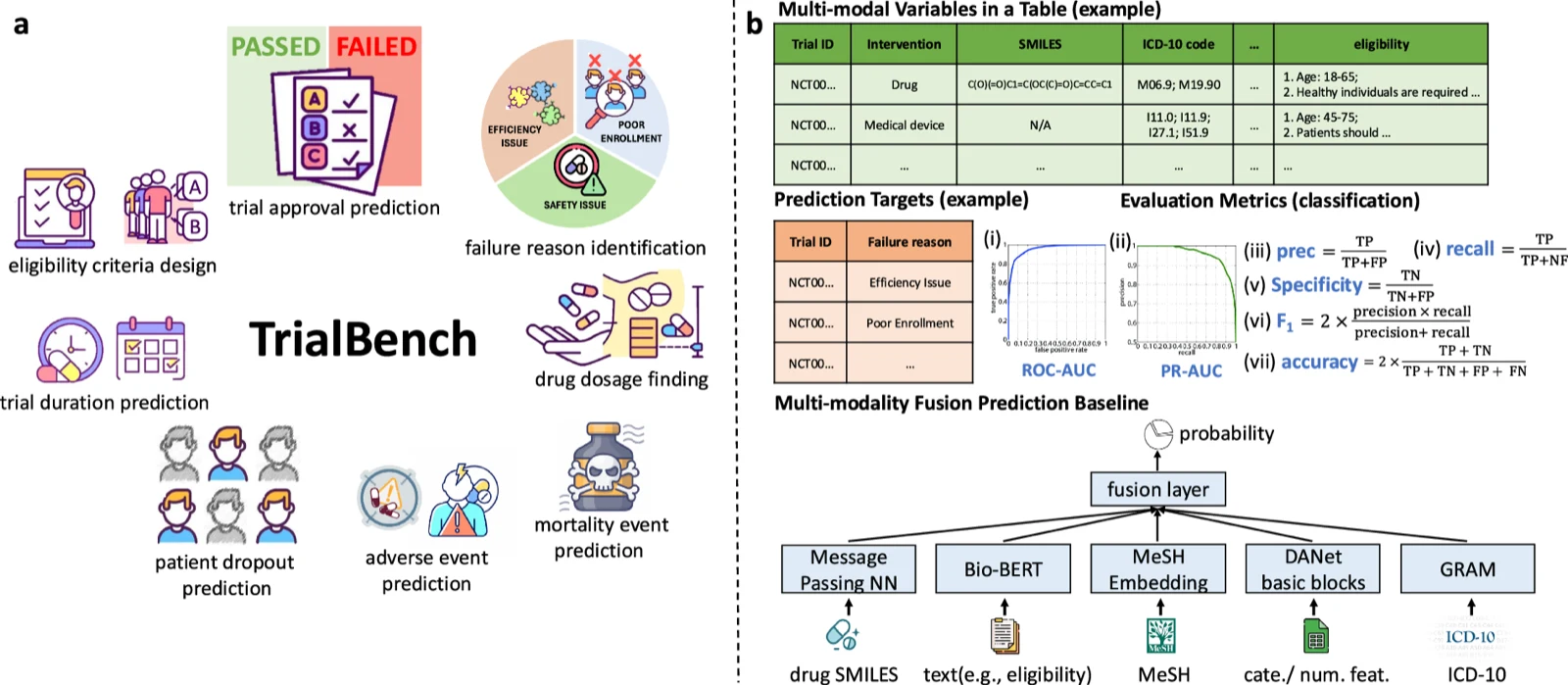
TrialBench's eight prediction tasks and its multi-modal baseline model
TrialBench's eight prediction tasks and its multi-modal baseline model. Figure from the paper.
Scientific Data · 2025

TrialBench: Multi-Modal AI-Ready Datasets for Clinical Trial Prediction

Chen et al. · led by Tianfan Fu, with Sunlab

The problem
Trial risks like mortality and enrollment failure can waste years of effort, but collecting and labeling trial data for AI requires medical expertise.
What we built
A suite of curated, multi-modal datasets from ClinicalTrials.gov covering tasks such as trial duration, dropout, adverse events, approval, failure reasons, and dose finding.
Why it matters
Released 23 open-access, AI-ready datasets across 8 trial-design tasks, each with a baseline model and validation methods.

Open-source tools

Software from this line of work that others can use and build on.

Want to work on this with us?

We work with students, clinicians, and industry partners. Email jimeng@illinois.edu.